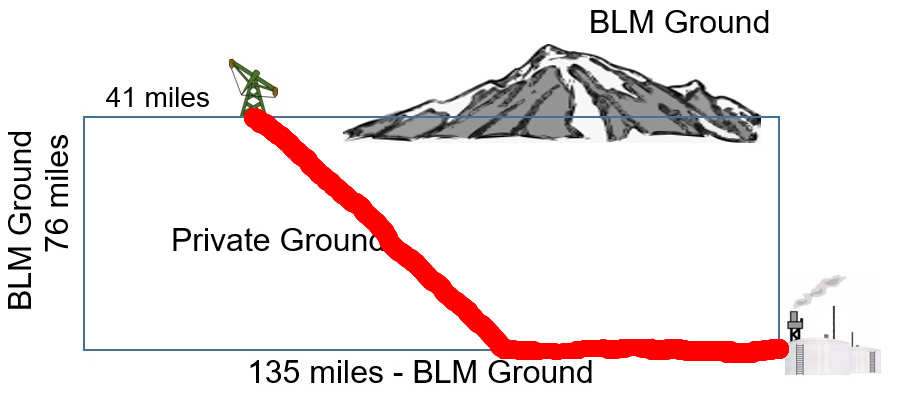
s The U.S. Interior Secretary recently approved drilling of natural gas wells near Vernal, Utah. Your company has begun drilling and established a high-producing well on BLM ground. They now need to build a pipeline to get the natural gas to their refinery.
While running the line directly to the refinery will be the least amount of pipe and shortest distance, it would require running the line across private ground and paying a right-of-way fee. There is a mountain directly east of the well that must be drilled through in order to run the pipeline due east.
Your company can build the pipeline around the private ground by going 41 miles directly west and then 76 miles south and finally 135 miles east to the refinery (see figure above). Cost for materials, labor and fees to run the pipeline across BLM ground is $98,000 per mile.
Cost of drilling through the existing mountain would be a one-time cost of $4,054,000 on top of the normal costs ($98,000 per mile) of the pipeline itself. Also the BLM will require an environmental impact study before allowing you to drill through the mountain. Cost for the study is estimated to be $88,000 and will delay the project by 5 months costing the company another $11,000 per month.
For any pipeline run across private ground, your company incurs an additional $32,000 per mile cost for right-of-way fees in addition to the normal costs ($98,000 per mile) of the pipeline itself.
Your company has asked you to do the following:
1. Determine the cost of running the pipeline strictly on BLM ground with two different cases:
One running west, south and then east to the refinery.
Per mile BLM : 98,000 dollars
West distance: 41 miles
South distance: 76 miles
East distance: 135 miles
Cost C:
C = 41 miles + 76 miles + 135 miles = 252 miles (98,000 dollars per mile) = 24,696,000 dollars
The cost to run the pipeline west, then south, then east to the refinery is 24,696,00 dollars.
One heading east through the mountain and then south to the refinery.
Drilling through mountain: 4,054,000 dollars
Impact study: 88,000 dollars
5 month delay: 55,000 dollars
West distance: 135 miles - 41 miles = 94 miles
South distance: 76 miles
Per mile BLM: 98,000 dollars
Cost C:
C = 94 miles + 76 miles = 170 miles (98,000 dollars per mile) =16,660,000 dollars
C = 16,660,00 dollars + 4,054,00 dollars + 88,000 dollars + 55,000 dollars = 20,857,000 dollars
The cost to run the pipeline east through the mountain and then south to the refinery would be 20,857,000 dollars. This option would be cheaper than the first option.
2. Determine the cost of running the pipeline on private ground and BLM ground with two different cases:
The shortest distance across the private ground to the refinery.
Per mile on private ground: 130,000 dollars
Shortest distance across private ground: 
Cost C:
C = miles(130,000 dollars) = 15,714,413.77 dollars
The cost to run the pipeline across the private ground straight to the refinery would be 15,714,413.77. This would be the cheapest option between the first two options.
Straight south across the private ground, then straight east to the refinery
Per mile on private ground: 130,000
Per mile BLM: 98,000
Distance south on private ground: 76 miles
Distance East on BLM: 94 mile
Cost C:
94 miles(98,000 dollars) + 76 miles(130,000 dollars) = 19,092,000 dollars
The cost to run the pipeline south across private ground and east on BLM ground to the refinery would be 19,092,000 dollars. This would be the second cheapest option we have so far.
3. Determine the cost function for the pipeline for the configuration involving running from the well across the private ground at some angle and intersecting the BLM ground to the south and then running east to the refinery. Use this function to find the optimal way to run the pipeline to minimize cost. Determine the length of pipe that runs across private land and how far from the refinery it starts running on BLM land. After finding the optimal pipe configuration, determine the angle at which your optimal path leaves the well. Clearly show all work including drawing the pipeline configuration. Make it very clear how you use your knowledge of calculus to determine the optimal placement of the pipeline.
Formula for the angle: 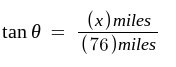
Formula for the distance: 

Function for the cost: 

Derivative of the cost function: 
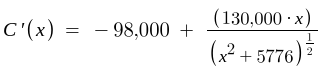

Minimum of cost function: 


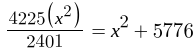


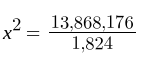

Angle:  degrees
Distance: 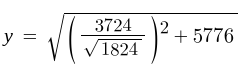
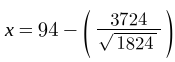
Minimum Cost: 
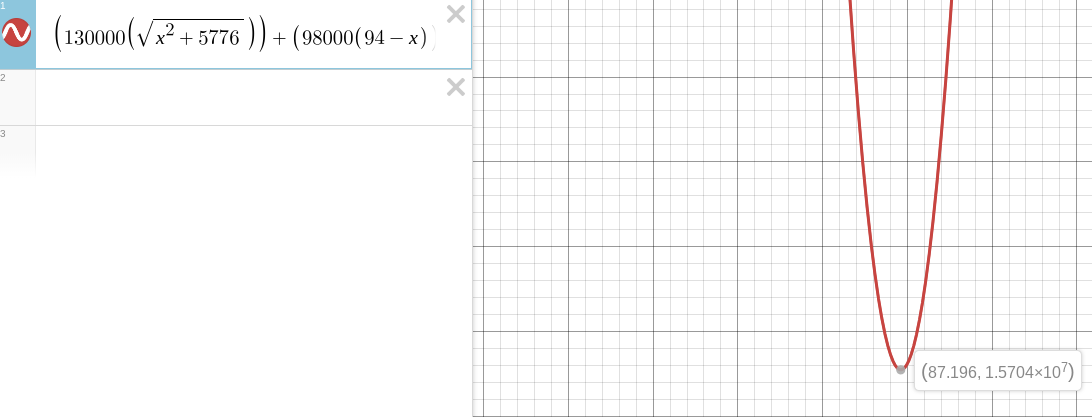
This option will start by going 48.92 degrees southeast for 115.67 miles and then east for 6.8 miles. The cost for this option is 15,703,663.58 dollars, which is the cheapest option there is.
4. Include a computer generated graph of the optimal cost function, “C(x)”, for this pipeline for any configuration involving crossing some private ground as well as some BLM ground. Make sure to use the correct domain of the function to scale your axes appropriately and to label the minimum point.
Reflection
Things that I've learned in this calculus class that would apply to the real world would be finding the rate of change or the velocity of an object. Also being able to find the acceleration of said object would be a useful real world tool. I think that calculus is one of the most important tools we have today. It is used in engineering, chemistry, biology, astronomy, physics, and has many more applications. Anything that needs to be precisely graphed or analyzed for a trend or change in something will need to use some form of calculus. Being a pre-engineering student, I know that any engineering field uses calculus extensively. Engineers need to be able to plan out anything that is being engineered and that will almost always require some form of calculus.